Sweat Equity in New Construction: Safe DIY vs. Builder Work
Thinking about sweat equity in your new build? Learn which projects homeowners can safely DIY and which parts are best left to your builder.
When a New Build Meets a Tight Budget
We recently got a call from a homeowner — let's call her Emily — who was in almost the exact situation described in that transcript. She and her husband had bought land, moved into an RV on-site, and were getting ready to submit for a building permit. They already had their own plans, their own kitchen cabinets, and even a couple of brothers lined up who knew how to frame. Their big question for us was simple:
“Can we put some sweat equity into our new home to save money, and what parts do we need to leave to you as the builder?”
We love that question, because when it’s done right, homeowner sweat equity can stretch a budget and make the finished home feel even more personal. But when it’s done wrong, it can cause schedule delays, inspection failures, and warranty headaches for everyone.
Using Emily’s situation as an example, we’ll walk through what homeowners can usually safely DIY in new home construction — and what really needs to stay in your builder’s court.
First Things First: Talk to Your Builder Up Front
On our call with Emily, the first thing we asked was which areas she and her family wanted to tackle. She mentioned:
- They already owned their kitchen cabinets.
- They had family with some framing experience.
- They were open to doing more if it truly saved money.
Before we ever said “yes” or “no,” we explained that any sweat equity has to be coordinated around three big factors:
- Building code and inspections – Some phases must be done by licensed trades.
- Scheduling – DIY work has to fit into a tight construction timeline.
- Warranty and liability – We can only warranty work we control and can verify.
That’s why the best time to bring up sweat equity is before you sign a contract, just like Emily did. It lets us build your DIY plans right into the scope, schedule, and pricing.
Good Sweat Equity Candidates: What Homeowners Can Often DIY
Painting and Interior Finishes
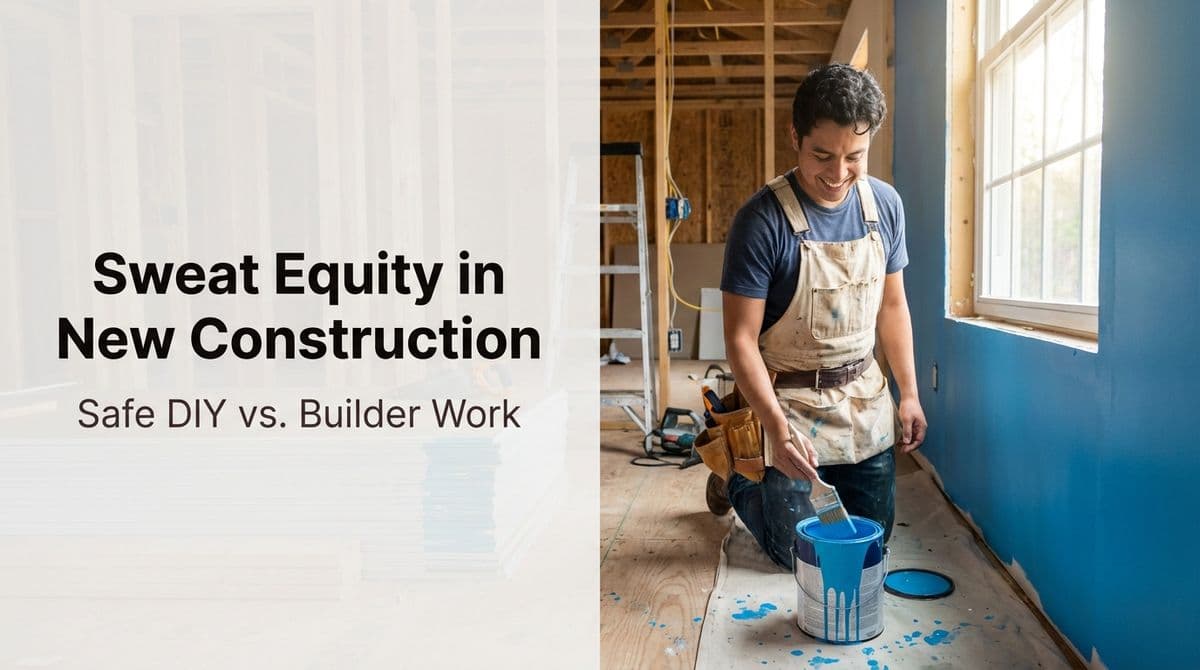
Painting is one of the first things we talk about when homeowners want to pitch in. It’s visible, it can be done after inspections, and the risk is relatively low if you’re patient and careful. With Emily, we suggested that she and her family consider taking on the interior painting once drywall was finished and primed.
Here’s how we typically coach homeowners through it:
- Prep the surfaces properly – Lightly sand the walls, vacuum dust, and wipe with a damp cloth. Fill nail pops and small dings with joint compound and sand smooth.
- Use painter’s tape and drop cloths – Protect trim, floors, and windows. A little time taping saves a lot of time cleaning up.
- Prime where needed – Fresh drywall usually needs a PVA primer. Stain-prone areas (like knotty wood) benefit from a stain-blocking primer.
- Work in the right order – Ceilings first, then walls, then trim and doors.
- Buy decent tools – A quality 2–2½" angled brush, 3/8"–1/2" nap rollers, and a sturdy extension pole make a big difference.
Common mistakes we warn folks about include painting too soon (before mud is fully dry), skipping primer, and not allowing enough drying time between coats. If painting is on your sweat equity list, we coordinate so we can pass inspections first and make sure other trades aren’t walking through your fresh paint.
Interior Trim, Hardware, and Shelving
Another area that can work for handy homeowners is finishing touches that don’t affect structure or systems. Depending on your skill level and our agreement, this might include:
- Installing closet shelving systems
- Hanging doors and installing door hardware
- Installing simple baseboard and casing in lower-visibility areas
- Mounting towel bars, toilet paper holders, and mirrors
With Emily, we offered the option of having our trim carpenter handle the tricky areas (stair trim, built-ins, tight corners) and letting her family do simple shelving and accessories later, after move-in. That split approach preserves quality where it matters most while still giving you room to contribute.
Landscaping and Exterior Clean-Up
We also talked with Emily about saving money outside. Landscaping is often a great sweat equity area because it comes at the end of the project and doesn’t affect building inspections. Homeowners can usually handle:
- Raking and leveling topsoil
- Spreading mulch or rock
- Planting trees, shrubs, and garden beds
- Simple irrigation (drip lines or hose-based systems), if local code allows
We’ll typically rough-grade the lot and complete any erosion-control measures, then you can come in after closing to customize the yard at your own pace.
"Gray Area" Tasks: Flooring and Cabinetry
Flooring: Sometimes DIY, Sometimes Not
Emily asked about how much flooring she and her family could take on. Our answer was: it depends on the type of flooring and your expectations.
As a general guide, here’s when DIY flooring can be reasonable:
- Floating vinyl plank (LVP) in bedrooms or closets with simple layouts.
- Laminate in low-moisture areas, assuming careful subfloor prep.
- Simple, square rooms without lots of doorways, angles, or transitions.
And here’s a quick checklist for when DIY flooring is not a good idea:
- You’re installing tile (especially in showers) or complex patterns.
- The area will see heavy moisture (bathrooms, laundry rooms, entries).
- The floor layout has lots of angles, stairs, or transitions.
- You’re on a tight schedule and can’t afford delays if something goes wrong.
- You expect a builder warranty on the finished floor.
In Emily’s case, we suggested a hybrid: we’d handle tile and any moisture-prone areas to protect her long-term, and she could consider installing click-together LVP in a couple of bedrooms after closing if she still wanted to add sweat equity.
Cabinets: Using What You Already Own
Emily already had her own kitchen cabinets, which is more common than you’d think. We’re usually open to homeowners supplying materials like cabinets as long as we can:
- Review measurements and layout ahead of time
- Verify quality and lead times
- Confirm who’s responsible if a piece doesn’t fit or arrives damaged
Sometimes homeowners want to install the cabinets themselves to save labor. For a custom new build, we often recommend leaving cabinet installation to our trim carpenter because cabinets set the stage for countertops, appliances, and tile backsplashes. A small error in level or layout can snowball quickly.
What Should Stay with Your Builder (No Sweat Equity Here)
There are certain phases we strongly advise homeowners not to DIY, and we shared this clearly with Emily on the phone:
- Foundation and structural framing – These affect the entire integrity of your home and must meet strict code and engineering specs.
- Electrical – Typically must be done by a licensed electrician and inspected. Safety and insurance are major concerns.
- Plumbing and HVAC – Same story: licensing, code, and long-term performance.
- Roofing and waterproofing – Leaks here can ruin everything below and void warranties.
- Window and exterior door installation – Critical for energy efficiency and water management.
We know some families, like Emily’s brothers, have framing experience. In very specific cases, we may let homeowners or family assist under our supervision, but we remain responsible for the final product. That usually means our crew leads the work, and we inspect everything before it’s covered up.
How We Set Up a Sweat Equity Agreement
As we wrapped up our call with Emily, we asked her to email her plans so we could review them and put together an estimate that included her sweat equity. When we do this, we put everything in writing so expectations are clear on both sides.
A solid sweat equity agreement with your builder will usually spell out:
- Exactly which tasks you’re responsible for (e.g., interior painting, closet shelving, final landscaping).
- When those tasks must be started and finished, and how they fit into the construction schedule.
- Quality standards and what happens if work doesn’t meet them (for example, the builder may have the right to bring in a pro and charge for corrections).
- Materials responsibility – who buys what, and who’s liable for shortages or defects.
- Warranty limits – which items the builder will warranty and which DIY items are excluded.
- Jobsite rules and insurance – safety requirements, access hours, and whether your participation is covered under the builder’s insurance.
We also like to include a simple communication plan: when we’ll walk the job with you, how we’ll approve completed DIY work, and what to do if you fall behind schedule. That way there are no surprises.
Is Sweat Equity Right for Your New Home?
By the end of our conversation, Emily realized that sweat equity isn’t about doing everything yourself — it’s about choosing the right pieces to tackle so you don’t put your home, your budget, or your timeline at risk. We helped her focus on areas where her family’s effort would really count, and we kept the complex, code-heavy work with our professional crews.
If you’re planning a new build and wondering where you can safely DIY, we’re happy to look over your plans and talk through options, just like we did for Emily. With a little planning and a clear agreement, sweat equity can be a smart way to stretch your budget and feel even more connected to the home you’re building.